
FishFORWRD | Fish and Fisheries OffshoRe Wind Research Database
FishFORWRD is a catalog of all East Coast research, monitoring efforts, and stated research needs for offshore wind, fish, and fisheries. The objective of FishFORWRD is to increase awareness of ongoing work, avoid duplication of efforts, and create a common understanding of research needs. This tool is meant for research funders, fisheries and offshore wind researchers, offshore wind developers, and the public. The webtool includes links to submit new projects, research needs, and corrections under the Submit Project tab.
last updated May 2026
View the associated executive summary here.
Research Gaps Analysis
The ROSA Research Gaps Analysis builds upon the FishFORWRD database to creates a common understanding of progress made and research still needed to understand the impacts of offshore wind on fish and fisheries on the U.S. East Coast.
Next Steps
The State of Offshore Wind Fisheries Science on the U.S. Atlantic Coast
ROSA is launching a webinar series to dive deeper into Gaps Analysis results. The Research Gaps Analysis identifies where research exists and what research needs are being addressed, but it does not capture what that research has found to date. With over half of the projects in FishFORWRD scheduled to be completed by the end of 2025, research and monitoring results are beginning to accumulate.
Click here to let us know which research categories to dive into first!
More Information on the Research Gaps Analysis
The Gaps Analysis draws on 240 research and monitoring projects cataloged in FishFORWRD and 323 individual research needs compiled from 17 research prioritization documents produced by federal and state agencies, fishing industry organizations, and regional management bodies.
Through a structured review process, these individual research needs were consolidated into 70 Summarized Research Needs (SRNs), which represent broader scientific questions and priorities within 11 research categories. Click here to view list of Summarized Research Needs
Each research and monitoring project in FishFORWRD was evaluated and mapped to one or more SRNs they address, enabling an assessment of whether each of the 70 summarized research needs are currently being explored by one or more projects or remain unaddressed, classifying each need as:
- Under Exploration – one or more existing projects are addressing the need, or
- Research Gap – no projects were identified as addressing that need.
Importantly, the Gaps Analysis evaluates research coverage rather than research conclusions. A research need classified as “under exploration” indicates that one or more projects are addressing the topic, but does not imply that the research question has been fully resolved. Similarly, a designation as a “research gap” does not necessarily indicate importance or priority, but rather highlights research needs with no projects addressing the topic within the current project portfolio in FishFORWRD.

Gaps Analysis Tool on FishFORWRD
Available now on FishFORWRD!
*Note: During preparation of this Final Report, the Summarized Research Needs (SRNs) were further refined to improve clarity and consistency across research categories. As a result, SRN numbering presented in this report may differ slightly from the numbering currently displayed in FishFORWRD as of March 2026. The next update to FishFORWRD will incorporate the updated results. As new research and monitoring projects come online, ROSA will continue to add projects to FishFORWRD and assign them to the relevant SRNs to maintain an updated Gaps Analysis.
Below is a short video on how to use the tool.
2025 Peer Review
In Summer 2025, ROSA held a Peer Review of the 2024 Research Gaps Analysis preliminary results pulling reviewers from the ROSA Research Advisors and other subject matter experts. The purpose of the Peer Review was to assess the methods used to conduct the analysis and validate the results. More information on the peer review process can be found in the final report.
2024 Preliminary Research Gaps Analysis
In Summer 2024, ROSA and our partner, WSP, Inc., worked together to perform a preliminary gaps analysis. Below is the presentation given to ROSA Advisory Council members and Research Advisors and the visualization of the results. This Miro Board provides a visualization of which research needs remain unmet and which are currently under investigation and how (by location, methodology, and receptor).
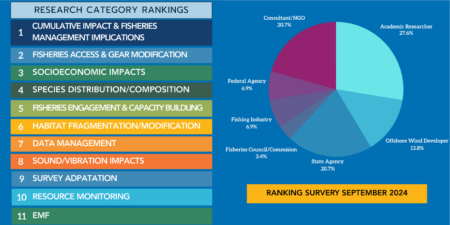
Input on the most pressing research categories and needs was solicited by ROSA Advisory Council members, Research Advisors, and interested stakeholders. ROSA used the preliminary gaps analysis results and input from the ranking survey to inform topic area selection for the ROSA Regional RFP 01.
FishFORWRD Sponsors